Common Mistakes to Avoid During Government Exam Preparation
Updated 15 Oct 2026 · 5 min read
Avoid common preparation mistakes such as studying without a plan, skipping revision and taking mock tests without reviewing them. Build a steady, practical routine for government exams.
| Subject | Questions | Marks |
|---|---|---|
| Reasoning | 25 | 50 |
Common Mistakes to Avoid During Government Exam Preparation
Preparing for a government job exam takes time, focus and a realistic plan. Many students work hard but lose progress through habits that can be corrected. Avoiding these common mistakes can help you use your study time more effectively.
1. Starting Without Understanding the Exam
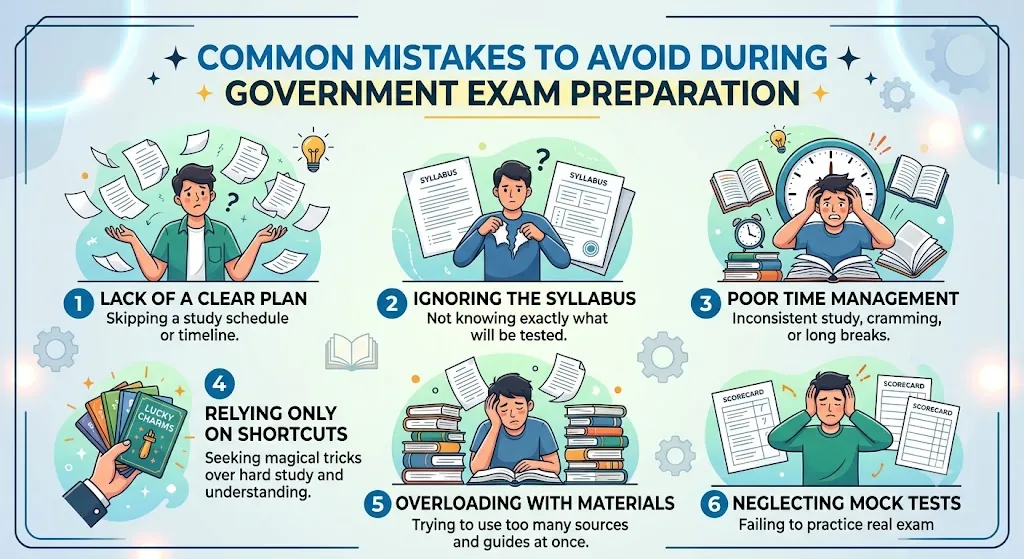
A common mistake is to begin studying before checking the exam pattern and syllabus. Different exams can test different subjects, question types and stages, so a plan made for one exam may not suit another.
Read the latest official notification and note the syllabus, selection stages, eligibility conditions and marking rules. For any official detail that is unclear or may change, check the official notification. Keep the syllabus handy and use it to decide what to study.
2. Collecting Too Many Study Resources
Buying or downloading many books, notes and online courses can feel like preparation, but it often leads to confusion. Students may switch between sources before completing any one of them.
Choose a small set of reliable resources that covers the syllabus. Use one main source for each subject, then add practice questions and previous papers where useful. If you change resources, do so because your current one is not working—not because a new one looks exciting.
3. Making an Unrealistic Timetable
A timetable with long study hours and no breaks is difficult to maintain. Missing one session can make you feel behind, which may lead to abandoning the plan altogether.
Set a routine that fits your daily responsibilities and energy levels. Break large topics into smaller tasks, include short breaks and leave some time for revision. Review your plan each week and adjust it if it is consistently too demanding.
4. Studying Passively
Reading a chapter again and again can create a sense of familiarity without showing whether you can recall or apply the information. This is especially risky when the exam includes timed problem-solving or objective questions.
After studying a topic, close your book and recall the main points. Solve questions without looking at the answers, and explain difficult ideas in your own words. This helps you find gaps before they become problems in a test.
5. Skipping Revision
Some students keep moving to new topics and leave revision until the final weeks. Without review, facts, formulas and concepts can become difficult to recall when you need them.
Plan regular revision from the beginning. You could review a topic after a short interval, revisit it later in the week and test yourself again after more time has passed. Keep concise notes of important rules, formulas and mistakes for quick review.
6. Avoiding Weak Subjects
It is natural to spend more time on subjects you enjoy. But leaving difficult topics untouched can limit your overall preparation and make the exam feel harder than it needs to be.
First identify the specific problem: is it a lack of understanding, slow calculation, weak vocabulary or careless errors? Work on one difficulty at a time. Practise basic questions before moving to harder ones, and ask a teacher or study partner for help when needed.
7. Taking Mock Tests Without Reviewing Them
A mock test is useful not only for checking your score but also for understanding your performance. Taking tests one after another without reviewing the answers may repeat the same mistakes.
After each test, examine questions you answered incorrectly, guessed or left blank. Note whether the cause was a knowledge gap, misreading, poor time use or an avoidable calculation error. Use that information to guide your next study session.
8. Ignoring Time Management and Exam Rules
Knowing a topic is not enough if you cannot attempt questions within the available time. On the other hand, rushing can lead to mistakes, especially when you have not practised under timed conditions.
Practise with a timer and try different question orders to find a method that suits you. Learn the exam’s rules about negative marking, section limits and allowed materials from the official notification. Do not assume that every exam follows the same rules.
9. Depending on Rumours or Unverified Information
Exam-related messages on social media can be outdated, incomplete or incorrect. Acting on them may lead to confusion about eligibility, dates, syllabus changes or application requirements.
Use official sources for important updates. Keep your application information and documents organised, and check every form carefully before submission. If you are unsure about a requirement, check the official notification rather than relying on a forwarded message.
10. Neglecting Health and Rest
Studying for very long hours while cutting down on sleep can reduce concentration and make recall harder. A routine that leaves no time for meals, movement or rest is also difficult to sustain.
Aim for regular sleep, short breaks and some physical activity. When you feel distracted or tired, a brief pause can be more helpful than forcing yourself to continue without focus. Consistency over time is more valuable than one exhausting study day.
Build a Better Preparation Routine
Start with the syllabus, choose dependable resources and divide your work into manageable tasks. Practise questions, revise regularly and use mock-test analysis to make targeted improvements.
You do not need a perfect plan; you need a plan you can follow and refine. Practise with a free mock test on SarkariJobers to check your preparation and identify what to work on next.
#government exams#exam preparation#study tips#mock tests